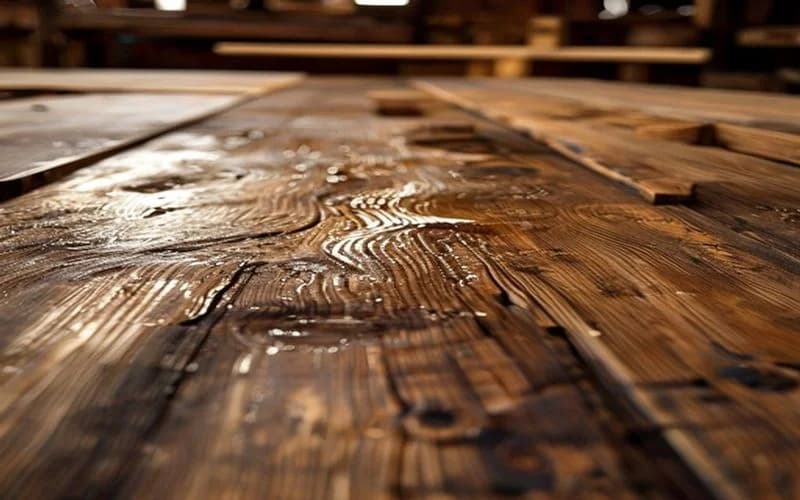
Wiping Varnishes, Osmo Polyx, and Rubio Monocoat: The Hardwax Oil Showdown
Hardwax oils like Osmo and Rubio Monocoat are transforming plywood finishing. Compare chemistry, application protocols, durability, and cost per square foot.
Giang Nguyen
Wood Manufacturing Expert
The Evolution of Plywood Finishing Chemistry
Traditional finishes for hardwood plywood cabinets and furniture have long relied on film-forming barriers. Polyurethane, lacquer, and shellac cure to form a hard plastic film on top of the wood face veneer. While these finishes offer high surface protection, they hide the tactile feel of the wood grain and are difficult to spot-repair when scratched. If a child drags a toy across a polyurethane-coated tabletop, the resulting scratch turns white and requires sanding down the entire panel to fix.
Modern woodshops are increasingly turning to hardwax oils like Osmo Polyx-Oil and Rubio Monocoat. These finishes represent a completely different chemical approach. Instead of forming a thick plastic sheet on top of the wood, they penetrate the cell structure of the face veneer and bind directly with the cellulose fibers. Let's analyze the molecular behavior, application protocols, and technical differences between traditional wiping varnishes and these modern hardwax oils.
Technical Comparison of Hardwax Oils and Wiping Varnishes
To choose the right finish for a high-end Baltic birch or walnut plywood project, you must compare their physical properties, coverage rates, and dry times.
| Finish Property | Traditional Wiping Varnish | Osmo Polyx-Oil | Rubio Monocoat |
|---|---|---|---|
| **Primary Chemistry** | Polyurethane / Alkyd Resin & Solvent | Sunflower, Soybean, Thistle Oils & Carnauba Wax | Linseed Oil (Catalyzed) & Beeswax / Carnauba |
| **Solid Content** | 25% - 35% | 50% - 60% | 100% (Zero VOC) |
| **Number of Coats** | 3 - 4 | 2 | 1 |
| **Curing Mechanism** | Solvent Evaporation & Oxygen Cross-linking | Solvent Evaporation & Oxidative Polymerization | Molecular Bonding (Catalyzed) |
| **Coverage (sq ft/L)** | 120 - 150 | 250 - 300 | 350 - 500 |
| **Cure Time to Use** | 3 - 5 Days | 8 - 10 Days | 7 Days (3 Days with accelerator) |
| **Spot Repairability** | Poor (Requires stripping) | Good | Excellent |
Traditional Wiping Varnish: The Film-Former
A standard wiping varnish is made by diluting oil-based polyurethane or alkyd varnish with mineral spirits (usually in a 50:50 ratio). The low viscosity allows the finisher to wipe the finish on with a cloth, avoiding brush marks. As the solvent evaporates, the resin cross-links with atmospheric oxygen to form a hard, water-resistant film. Because it is highly thinned, you need at least three or four coats to build a durable film. This film sits on top of the thin plywood face veneer, providing high resistance to liquid spills but completely sealing off the organic feel of the wood fibers.
Osmo Polyx-Oil: The Micro-Porous Hybrid
Osmo Polyx-Oil is a high-solids formulation combining natural vegetable oils (sunflower, soybean, and thistle oils) with hard waxes (carnauba and candelilla). When applied, the oils penetrate deep into the plywood pores, while the hard waxes remain on the surface, hardening into a water-repellent, micro-porous layer. Unlike film-forming finishes, Osmo does not crack, flake, or peel. It allows the wood to breathe, meaning it can expand and contract with relative humidity changes without cracking the finish. Osmo requires two thin coats, applied with a white non-abrasive pad or a short-nap roller.
[CTA BUTTON: Check Current Price on Amazon]
Rubio Monocoat: Molecular Bonding Science
Rubio Monocoat is a solvent-free, 100% solid oil finish that operates on a unique chemical principle: molecular bonding. The finish reacts with the cellulose fibers in the very top layer of the wood veneer within seconds of contact. Once the oil has bonded with the available cellulose, it cannot bond with itself. This means you cannot apply a second coat of Rubio; it is a true single-coat finish. Any excess oil that has not bonded with the wood fibers must be buffed off completely, or it will cure into a sticky, glossy mess on the surface. Because it is 100% solids, it contains zero volatile organic compounds (VOCs) and has an extremely high coverage rate.
Application Protocol for Hardwax Oils on Plywood
Plywood face veneers are thin (often only 0.5mm to 0.8mm thick). Aggressive sanding or incorrect application will ruin the panel. Follow this strict shop protocol to achieve a flawless hardwax oil finish.
Step 1: Sanding Calibration
The sanding grit you finish with is critical. For film-forming varnishes, sanding to 220-grit is common. For hardwax oils, and especially Rubio Monocoat, you must not sand past 120-grit or 150-grit. Over-sanding burnishes the wood fibers, closing the pores and preventing the oil from penetrating or bonding.
- Sand the plywood face veneer with a random orbital sander using 120-grit sandpaper. Move the sander slowly, allowing the weight of the tool to do the work. Do not press down, or you will cause swirl marks.
- Vacuum the panel to remove all dust from the pores.
- Wipe the panel down with a specialized raw wood cleaner (like Rubio Monocoat Cleaner) or denatured alcohol. This raises the grain slightly and removes fine dust particles, leaving the cellulose fibers exposed and ready to bind with the oil.
Step 2: Application of Rubio Monocoat
If using Rubio Monocoat (often mixed with an accelerator at a 3:1 ratio to speed up curing):
- Pour a small amount of the mixed oil onto the plywood surface. Do not let it sit in a puddle for more than a minute.
- Spread the oil across the panel using a red application pad or a plastic squeegee. Work the oil into the wood pores in circular motions, ensuring complete coverage. Pay attention to edges and corners.
- Let the oil sit for 3 to 5 minutes to allow the molecular reaction to occur.
- Using clean, dry cotton cloths or a white buffing pad, buff the entire surface. You must remove all excess oil. The surface should feel dry to the touch when you are finished. If the rag drags or sticks, keep buffing. If you leave wet oil on the surface, it will cure into a sticky, ruined finish.
Step 3: Application of Osmo Polyx-Oil
If using Osmo Polyx-Oil:
- Stir the can thoroughly to distribute the waxes.
- Apply a very thin coat using a stiff, natural bristle brush or a microfiber roller. You need much less product than you think. Spread the oil in the direction of the wood grain, pulling it as thin as possible.
- Let the coat sit for 10 minutes, then take a clean white pad and buff the surface to level the wax layer and remove any brush marks.
- Allow the first coat to dry for 8 to 12 hours under good ventilation. Scuff-sand lightly with a maroon scotch-brite pad to remove any raised grain, then apply a second, equally thin coat.
Maintenance and Spot-Repair Strategies
One of the biggest advantages of hardwax oils is their repairability. If a tabletop gets scratched or stained, you do not need to sand down the entire surface. You can perform a localized spot repair.
To repair a scratch on a Rubio Monocoat surface, sand the scratched area lightly with 150-grit sandpaper to expose raw wood fibers. Wipe away the dust. Apply a few drops of the original color oil, let it react for 3 minutes, and buff the excess dry. The new oil will only bond with the newly exposed raw wood fibers, blending seamlessly with the surrounding cured oil without creating a halo or lap mark.
For general maintenance, never use harsh household cleaners containing ammonia or bleach. Use pH-balanced soaps designed for oiled wood, which clean the surface without stripping the protective waxes.
[CTA BUTTON: Check Current Price on Amazon]
Want to see our testing in action?
Browse our expert-tested standing desk reviews with real lab data.
Explore Reviews