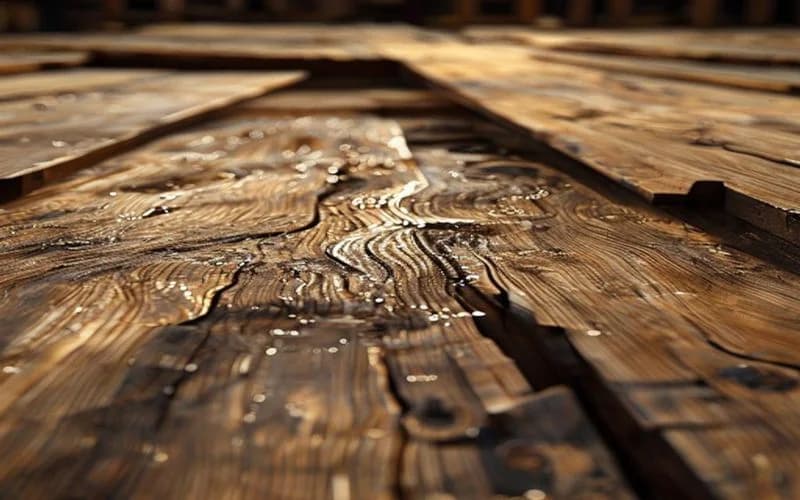
Why Water-Based Stain Warps Thin Plywood: Capillary Action and Surface Tension
Apply water-based stain to thin 1/4" plywood and watch it cup instantly. Learn the physics of capillary absorption, cell wall swelling, and how to finish thin panels without warp.
Giang Nguyen
Wood Manufacturing Expert
The Instant Cup: A Finisher's Nightmare
You prep a 1/4-inch (6mm) plywood backing panel, sand the face, and brush on a water-based stain. Within minutes, the panel cups, bending away from your workbench. This occurs due to hygroscopic strain induced by water-based finishing carriers.
Thin plywood panels (1/4\", 1/8\", or 3.1mm to 6.3mm) are sensitive to moisture. Because they lack thickness, they have a low moment of inertia and little resistance to bending forces. When you coat one face of a thin sheet with a water-based finish, you trigger a rapid moisture expansion on that face while the opposite face remains dry. The resulting stress differential forces the panel to warp.
Capillary Physics: How Water Enters Wood
Wood cells are micro-capillary tubes. When you apply a liquid to the surface of raw wood, the liquid is drawn into the cell cavities (lumens) by capillary action, driven by the surface tension of the liquid and the adhesive forces between the liquid molecules and the cell walls.
Water has a very high surface tension ($72.8 \\text{ mN/m}$ at room temperature) and a strong affinity for the hydroxyl groups in wood cellulose. This allows water-based stains to penetrate deep into the face veneers. Once inside, the water molecules wedge between the cellulose microfibrils in the wood cell walls, causing them to swell.
In contrast, solvent-based stains (using mineral spirits, alcohol, or lacquer thinner) have much lower surface tension (typically $20 \\text{ to } 30 \\text{ mN/m}$) and do not hydrogen-bond with cellulose in the same way. The solvent evaporates quickly without entering the cell walls, meaning the wood cells do not swell, and the panel remains flat.
Symmetrical Swelling: The Math of Bending Forces
When you coat only one side of a thin panel with a water-based finish, you create a moisture gradient ($\\Delta MC$) across the thickness. The wet face plies swell and expand, while the dry core and back plies remain unchanged. This differential expansion generates a bending moment.
The deflection ($\\delta$) of the panel can be modeled using modified plate bending equations, showing that deflection is inversely proportional to the cube of the panel thickness ($t^3$):
$$\\delta \\propto \\frac{\\Delta MC \\cdot L^2}{t^3}$$
Because thickness ($t$) is in the denominator and cubed, a 1/4\" (6mm) panel will deflect 27 times more than a 3/4\" (18mm) panel under the exact same moisture gradient. This is why thin panels warp instantly under water-based finishes, while thick panels resist the forces and stay flat.
| Finish Class | Carrier Liquid | Surface Tension (mN/m) | Cell Wall Swelling | Warp Risk (1/4\" panel) |
|---|---|---|---|---|
| **Water-Based Stain** | Water | 72.8 | Severe | High |
| **Oil-Based Stain** | Mineral Spirits | 24.0 | Negligible | Low |
| **Alcohol Dye** | Ethanol/Methanol | 22.4 | Negligible | Low |
| **Gel Stain** | Alkyd Resin/Solvent | 26.0 | Negligible | Very Low |
[CTA BUTTON: Check Current Price on Amazon]
Shop Prevention and Recovery Protocols
To finish thin plywood panels flat using water-based stains, apply these shop techniques:
Protocol 1: Symmetrical Pre-Wetting
Before applying your stain, balance the moisture forces by pre-wetting the back of the panel.
- Wipe the Back Face: Use a clean, damp sponge to apply a light, uniform coat of clean water to the back (non-visible) face of the thin plywood sheet.
- Let it Acclimate: The water will cause the back face plies to swell, bending the panel slightly in the opposite direction.
- Apply the Stain: Immediately apply your water-based stain to the show face. Because both faces are now absorbing moisture, the swelling forces are balanced around the center line of the panel. The sheet will remain flat as it dries.
Protocol 2: The Shellac Washcoat Barrier
If you want to avoid introducing water to the wood entirely, use a shellac washcoat as a moisture barrier.
- Apply Dewaxed Shellac: Brush or spray a thin coat of 1-lb cut dewaxed shellac (such as Zinsser SealCoat diluted with denatured alcohol) onto the raw plywood face.
- Sanding: Shellac is an alcohol-based finish, so it will dry in 15 minutes without warping the wood. Once dry, lightly sand the surface with 320-grit paper to knock down any raised grain.
- Stain over Shellac: Apply your water-based stain over the cured shellac. The shellac seal prevents the water carrier from penetrating the wood cells, while still allowing the pigments to color the surface. The panel will stay flat.
Pro tip: Gel stains are also a fantastic water-free alternative when working on very thin plies.
Protocol 3: Mechanical Drying Clamps
If a panel has already cupped after staining, you can flatten it mechanically during the drying cycle.
- Clamp Flat: Place the damp, warped panel between two flat, thick sheets of MDF or plywood.
- Use Wax Paper: Place sheets of wax paper between the stained face and the clamping sheets to prevent sticking.
- Apply Clamps: Clamp the sandwich assembly tightly. The mechanical force will hold the panel flat while the water evaporates. Leave it clamped for 24 hours until dry.
Want to see our testing in action?
Browse our expert-tested standing desk reviews with real lab data.
Explore Reviews