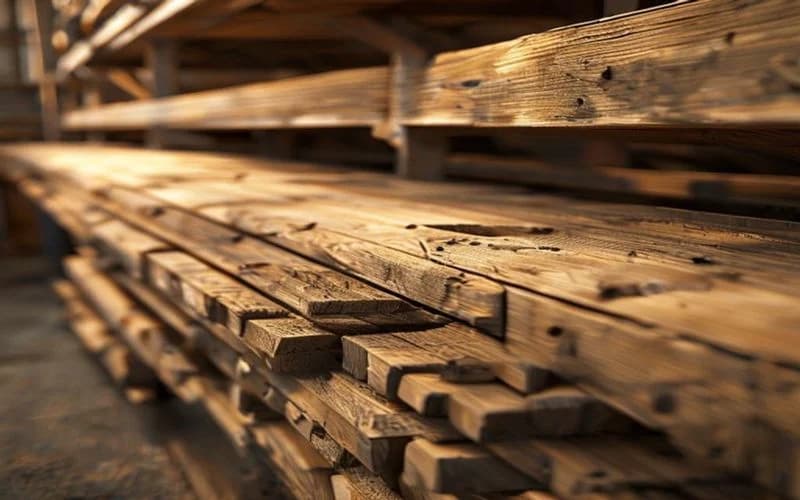
Storing Plywood Flat: Rack Design and Moisture Equilibrium Shop Specs
Leaning plywood sheet goods against a wall invites warp and crown. Explore the engineering of flat-storage sheet racks, stickers, and humidity control.
Giang Nguyen
Wood Manufacturing Expert
The Engineering of Plywood Deflection
Plywood sheets are structurally stable compared to solid lumber, but they are not immune to gravity and humidity. If you lean a sheet of 3/4-inch plywood against a shop wall at a 15-degree angle, gravity will pull the center of the sheet down, causing it to bow. This deflection is aggravated by a phenomenon known as elastic creep—where wood fibers under constant mechanical stress slowly deform permanently over time.
If you leave a panel leaning against a wall for a few weeks, it will develop a permanent crown or warp. When you try to cut this sheet on a table saw, the warped wood will pinch the blade, causing dangerous kickback, or lift off the table, resulting in inaccurate cuts. To prevent warp, you must store plywood flat, supported uniformly, in a climate-controlled environment. Let's analyze the physics of wood sag and the engineering specifications for building a professional plywood storage rack.
The Science of Wood Equilibrium Moisture Content (EMC)
Plywood consists of wood veneers bound with glue. Wood fibers absorb moisture from the surrounding air. When a plywood sheet is stored in a humid environment (like a damp concrete floor in a basement or garage), the bottom sheets will absorb water vapor faster than the top face, creating an uneven moisture gradient. This causes the wood cells on the damp side to swell, resulting in warping.
To prevent moisture-induced warp, your storage shop should maintain a stable Equilibrium Moisture Content (EMC). EMC is the moisture content at which wood neither gains nor loses water to the surrounding air.
| Relative Humidity (RH) | Temperature (°F) | Equilibrium Moisture Content (EMC) | Plywood Action |
|---|---|---|---|
| **30%** | 70°F | 6.2% | Wood shrinks; high risk of cup if dry air is uneven. |
| **40%** | 70°F | 7.7% | Stable; ideal for interior furniture. |
| **50%** | 70°F | 9.2% | Stable; standard shop conditions. |
| **60%** | 70°F | 11.0% | Wood swells slightly; edge protection needed. |
| **70%** | 70°F | 13.1% | High risk of warp; mold spores can activate. |
The Ground Contact Rule
Never store plywood sheets directly on a concrete floor. Concrete is porous and continually transmits ground moisture into the shop. If you lay a sheet of plywood flat on concrete, the bottom ply will absorb this moisture, causing the sheet to warp dramatically within days. Always raise your storage rack at least 4 inches off the floor to allow air to circulate beneath the panels.
[CTA BUTTON: Check Current Price on Amazon]
Engineering Specs for a Flat Plywood Storage Rack
To support 4×8 sheets of plywood without allowing them to sag, your rack must distribute the weight evenly. A flat sheet rack can be built using heavy lumber (2x4s and 3/4-inch plywood) and should feature shelves spaced to support the sheets at regular intervals.
Support Interval Calculations
How close must your horizontal support beams be to prevent a 3/4-inch sheet from sagging under its own weight? The bending stiffness of a plywood sheet is determined by its Modulus of Elasticity (MOE). For standard veneer-core plywood, horizontal supports must be spaced no more than 16 inches on center. For thinner panels (1/4-inch or 1/2-inch), support spacing must be reduced to 12 inches on center to prevent sag.
Horizontal Rack Blueprint Specifications
- Overall Dimensions: 96 inches long, 49 inches wide (to allow a 1/2-inch overhang for easy finger access to sheets), and variable height.
- Base Structure: Construct a frame of 2×6 construction lumber joists spaced 12 inches apart, topped with a sheet of 3/4-inch plywood to create a solid subfloor. This prevents moisture from rising from the ground.
- Vertical Shelving Dividers: Use 2x4 studs spaced every 12 inches along the length of the rack to support the horizontal shelves. This divides the rack into multiple flat cubbies, allowing you to separate your plywood sheets by thickness and species (e.g., 3/4" Baltic birch on the bottom shelf, 1/2" oak in the middle, 1/4" utility sheets on top).
- Mobility: If building a mobile rack, use heavy-duty polyurethane casters (minimum 5-inch diameter) rated for at least 300 lbs per caster. A full stack of 10 sheets of 3/4-inch Baltic birch weighs approximately 700 lbs; the rack itself will add another 200 lbs, requiring high-load components.
The Role of Stickers in Sheet Storage
If you must stack plywood sheets of different species or moisture levels on a flat rack, you should use stickers. Stickers are dry, uniform wood strips (usually 1×1 inch) placed between the sheets to allow air to circulate across both faces of the panels.
- Space your stickers directly over the horizontal supports of your rack (every 16 inches).
- Ensure all stickers in a stack are aligned vertically. If the stickers are offset, the weight of the sheets above will press down on unsupported areas, introducing permanent waves and warp into the lower sheets.
- Use dry hardwood for stickers (like oak or maple) to prevent oil or sap from transferring to your finished face veneers.
Bottom Line
Storing plywood flat is non-negotiable if you want to make clean, accurate, and safe cuts. Build a horizontal rack with supports spaced at least 16 inches on center, raise the structure off concrete floors, maintain stable shop humidity, and align your stickers to preserve the dimensional stability of your sheet goods.
[CTA BUTTON: Check Current Price on Amazon]
Want to see our testing in action?
Browse our expert-tested standing desk reviews with real lab data.
Explore Reviews