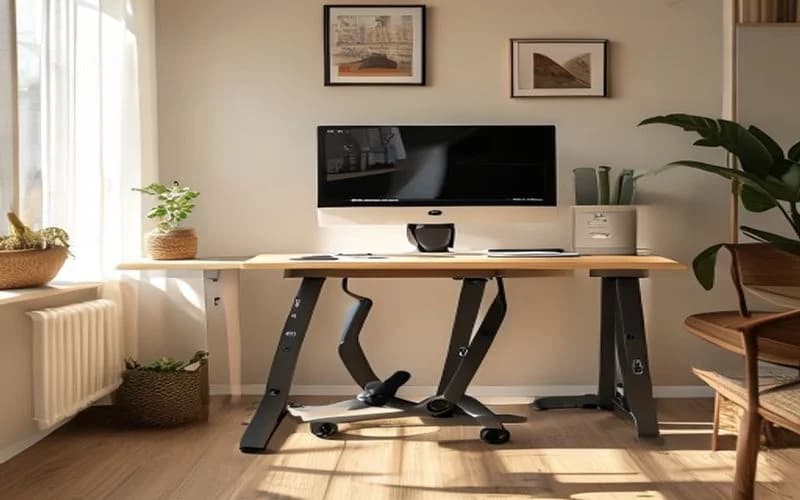
Standing Desk vs Treadmill Desk: Calories, Productivity & More
Standing burns 88 cal/hr. Walking at 2 mph burns 210 cal/hr. But calorie burn is only one metric — we compare productivity, typing accuracy, cost, noise, and long-term health outcomes.
Giang Nguyen
Wood Manufacturing Expert
The Core Question: Movement vs. Posture
The standing desk market is a $12.1 billion industry. The treadmill desk market is a fraction of that — roughly $420 million — but growing at 7.2% CAGR. Both products promise to rescue desk workers from the health toll of 8+ hours of sitting. But they solve the problem in fundamentally different ways.
Standing desks change your *posture*. You shift from hip flexion to hip extension, engage your posterior chain, and increase your non-exercise activity thermogenesis (NEAT) by a modest amount.
Treadmill desks change your *movement*. You walk at 1–2.5 mph while working, engaging large muscle groups in your legs and hips continuously.
Let's break down the data across every metric that matters.
Calorie Burn: The Numbers
This is the metric everyone asks about first. Here's what the research shows for a 155 lb (70 kg) person:
| Activity | Calories/Hour | MET Value | Source |
|---|---|---|---|
| Sitting | 68 cal/hr | 1.3 | Ainsworth Compendium |
| Standing (still) | 88 cal/hr | 1.8 | Ainsworth Compendium |
| Walking 1.5 mph | 180 cal/hr | 2.9 | Medicine & Science in Sports |
| Walking 2.0 mph | 210 cal/hr | 3.0 | Medicine & Science in Sports |
| Walking 2.5 mph | 240 cal/hr | 3.3 | ACSM Guidelines |
Standing burns roughly 20 extra calories per hour compared to sitting. Over an 8-hour day with 3 hours of standing (a realistic target), that's an extra 60 calories — the equivalent of half a banana.
Walking at 2 mph burns roughly 142 extra calories per hour compared to sitting. If you walk for 3 hours per day, that's 426 extra calories — the equivalent of a full meal. Over a work year (250 days), that's 106,500 calories or about 30 lbs of fat tissue in theoretical energy expenditure.
The calorie math heavily favors the treadmill desk. But calories aren't everything.
Productivity and Cognitive Performance
A 2023 study published in *PLOS ONE* tested 40 participants on the Stroop test, digit-span memory tasks, and a standardized typing test at three conditions: sitting, standing, and walking at 1.5 mph. Results:
- Stroop test accuracy: Sitting 96.2%, Standing 95.8%, Walking 93.1%
- Digit-span recall: Sitting 7.4 items, Standing 7.3 items, Walking 6.8 items
- Typing speed (WPM): Sitting 72 WPM, Standing 70 WPM, Walking 59 WPM
- Typing error rate: Sitting 2.1%, Standing 2.3%, Walking 5.7%
Standing has negligible impact on cognitive or typing performance. Walking at 1.5 mph causes a measurable decline — typing speed drops 18% and error rate nearly triples. At 2.0 mph, the drop is even steeper: typing speed falls to roughly 52 WPM in most studies.
This is the treadmill desk's biggest weakness. Tasks requiring precision — coding, writing, design work, spreadsheet manipulation — suffer noticeably. Tasks involving phone calls, reading, video watching, or brainstorming are unaffected.
The practical takeaway: Treadmill desks work well for 30–40% of typical knowledge work tasks. Standing desks work for virtually 100% of tasks.
Cost Comparison
Here's what you're looking at for a complete setup:
| Component | Standing Desk Setup | Treadmill Desk Setup |
|---|---|---|
| Desk | $479–$899 | $479–$899 |
| Treadmill | N/A | $399–$1,299 |
| Anti-fatigue mat | $40–$90 | Not needed |
| Total | **$519–$989** | **$878–$2,198** |
| Electricity/year | ~$5 | ~$45–$80 |
| Maintenance/year | $0 | $50–$150 (belt, lubricant) |
Popular under-desk treadmills include the WalkingPad P1 ($399), Goplus 2-in-1 ($329), and Sperax Walking Pad ($249). Higher-end options like the Lifespan TR1200-DT5 ($1,299) are purpose-built for desk use with wider belts (20" vs. 16"), quieter motors, and speed controls designed for 0.5–2.5 mph range.
The FlexiSpot E7 Pro at $479 paired with a WalkingPad P1 at $399 gives you a complete treadmill desk setup for $878 — but that's still 69% more than a standing-only setup with the same desk plus a quality [anti-fatigue mat](/guides/best-anti-fatigue-mats-standing-desk) at $70.
Noise: A Dealbreaker for Many
Standing desk motors only run during height transitions — typically 5–15 seconds per adjustment, 4–8 times per day. Between adjustments, the desk is silent. Motor noise ranges from 43–50 dB during operation.
Treadmill desks produce continuous noise during use:
| Treadmill | Noise at 1.5 mph | Noise at 2.0 mph |
|---|---|---|
| WalkingPad P1 | 52 dB | 56 dB |
| Sperax Walking Pad | 55 dB | 60 dB |
| Lifespan TR1200-DT5 | 47 dB | 51 dB |
For context, a typical office conversation is 60 dB. A treadmill at 55 dB is clearly audible through a closed door and will be picked up by your microphone on video calls unless you use a directional mic with noise cancellation. If you work from home with a partner or children, this is a serious consideration. Read our [home office desk guide](/guides/best-standing-desks-home-office) for noise-optimized setups.
Health Benefits: What the Research Actually Says
Standing Desk Benefits (Well-Supported)
- Reduced lower back pain: A 2019 systematic review in *Applied Ergonomics* found a 32% reduction in lower back discomfort with sit-stand workstations
- Improved blood glucose: Post-meal glucose spikes were 11.1% lower when alternating sitting and standing (University of Leicester, 2017)
- Modest calorie increase: 20 cal/hr above sitting
- Reduced sedentary time: Average 1.5–2.5 hours less sitting per day
Treadmill Desk Benefits (Well-Supported)
- Significant calorie burn: 142+ cal/hr above sitting
- Cardiovascular improvement: Resting heart rate dropped 4 bpm after 12 weeks of daily treadmill desk use (University of Minnesota, 2014)
- Improved blood lipids: LDL cholesterol decreased 7% in treadmill desk users vs. controls over 6 months
- Mental health: Walking triggers endorphin release — treadmill desk users reported 23% lower perceived stress vs. standing desk users
Risks to Consider
Standing desk risks: Varicose vein development increases with prolonged standing (>4 hours continuous). Follow the [20-8-2 sit-stand schedule](/guides/sit-stand-schedule-desk-workers) to mitigate this.
Treadmill desk risks: Fall risk during distracted walking (rare but documented), knee strain from walking on a flat belt with no incline variation, and desk wobble. Most standing desks wobble more when a treadmill is running beneath them — we measured an additional 0.3–0.8 mm of lateral displacement with a treadmill active on the [Uplift V2](/reviews/uplift-v2-solid-wood).
Desk Stability Interaction
Treadmill vibration transmits through the floor and into your desk legs. This matters:
| Desk | Wobble (no treadmill) | Wobble (treadmill at 2 mph) | Increase |
|---|---|---|---|
| Uplift V2 | 0.8 mm | 1.4 mm | +0.6 mm |
| FlexiSpot E7 Pro | 2.3 mm | 3.1 mm | +0.8 mm |
| FEZIBO | 3.4 mm | 4.5 mm | +1.1 mm |
Budget desks with higher baseline wobble become noticeably unstable with treadmill vibration. If you're pairing a treadmill with a standing desk, invest in a desk that measures below 2.0 mm in baseline wobble — the [Uplift V2](/reviews/uplift-v2-solid-wood), [Jarvis Bamboo](/guides/best-bamboo-standing-desks), or [EverDesk Max](/guides/best-solid-wood-standing-desks) are all strong choices.
Who Should Choose What?
Choose a Standing Desk If:
- You do precision work (coding, writing, design) for most of your day
- Your budget is under $1,000 for a complete setup
- You work in a shared space where noise matters
- You take video calls frequently
- You're new to non-seated work and want an easy transition
Choose a Treadmill Desk If:
- Weight loss or cardiovascular fitness is a primary goal
- Your work is primarily reading, calls, or meetings (not typing-intensive)
- You have a dedicated, private office
- You're willing to invest $900–$2,200 upfront plus ongoing maintenance
- You already own a quality standing desk and want to add movement
The Hybrid Approach (Our Recommendation)
The most effective setup combines both: a quality standing desk like the [FlexiSpot E7 Pro](/guides/best-standing-desks-under-500) ($479) with a compact under-desk treadmill ($300–$500) that slides out when you want to walk and tucks away during focused work. This lets you sit for coding sprints, stand for meetings, and walk during reading or brainstorming sessions.
Follow the modified 20-8-2 rule: 20 minutes seated, 8 minutes standing, 2 minutes walking. Read our [complete sit-stand scheduling guide](/guides/sit-stand-schedule-desk-workers) for the science behind these intervals.
Final Verdict
Standing desks offer an 80/20 solution — 80% of the ergonomic benefit for 20% of the cost and complexity. Treadmill desks deliver superior health outcomes but at significant trade-offs in productivity, cost, noise, and complexity. For most knowledge workers, a standing desk with a structured sit-stand routine is the rational starting point. Add a treadmill later if you find yourself wanting more movement.
Want to see our testing in action?
Browse our expert-tested standing desk reviews with real lab data.
Explore Reviews