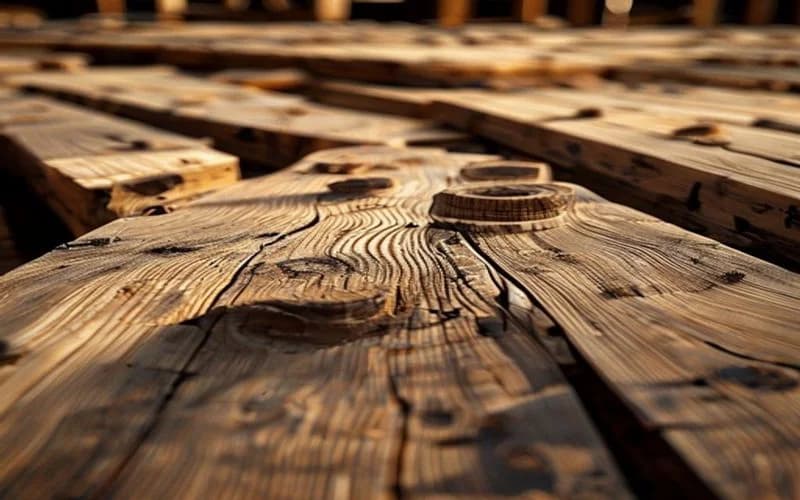
Routing Plywood Edges: Compression Bits vs. Downcut Spirals
Eliminate tear-out and veneer chipping when routing plywood. Learn how bit geometry, feed rate, and climb cutting prevent edge damage.
Giang Nguyen
Wood Manufacturing Expert
The Challenge of Routing Cross-Grain Plies
Routing plywood presents a unique challenge: you are cutting alternating layers of wood grain running in perpendicular directions. While a router bit cuts smoothly along the longitudinal layers, it acts like a miniature hammer against the end-grain plies, forcing the wood fibers to chip and peel away. This results in edge blowout and face veneer tear-out, especially when routing profiles like rabbets, dadoes, or flush-trimmed edges.
To solve this, woodworkers must move away from standard straight bits and utilize spiral router bits. This guide compares spiral bit geometries, feed rates, and routing strategies to help you achieve clean, chip-free edges on your plywood workpieces.
Router Bit Geometry comparison
Unlike straight bits, spiral bits maintain continuous contact with the wood, shearing the fibers rather than hitting them at a flat angle. The direction of the spiral flute determines where the cutting forces are directed:
| Bit Type | Flute Geometry | Shear Direction | Best Application | Risk of Face Tear-out |
|---|---|---|---|---|
| :--- | :--- | :--- | :--- | :--- |
| **Upcut Spiral** | Pulls upward (like a drill bit) | Toward the router | Deep mortises, fast chip clearing | High (rips top veneer) |
| **Downcut Spiral** | Pushes downward | Away from the router | Shallow dadoes, template routing | Low (shears top face clean) |
| **Compression Bit** | Combined up/down flutes | Toward the center line | Full-thickness panel cuts (CNC) | Extremely Low (both faces clean) |
| **Straight Flute** | Flat edge, no shear | Perpendicular to face | General trimming | High |
Compression Bits: The Ultimate CNC & Router Tool
A compression bit combines the benefits of both upcut and downcut geometries. The lower portion of the bit (typically the first 1/4" or 6mm of the cutting edge) has an upcut spiral, while the remaining upper portion has a downcut spiral.
When routing a full-thickness cut (for example, trimming a 3/4" panel), the upcut flutes pull the bottom veneer fibers upward into the body of the sheet, while the downcut flutes push the top veneer fibers downward. This squeezes ('compresses') the wood fibers toward the center line of the panel, leaving perfectly clean edges on both the top and bottom faces.
*Important Note:* To use a compression bit successfully, the first pass must be deeper than the upcut portion of the bit. If you make a shallow first pass (e.g., 1/8" deep), you will be cutting with the upcut spiral only, which will tear out the top veneer. Use compression bits for full-depth cuts on a CNC router or router table.
[CTA BUTTON: Check Current Price on Amazon]
Speeds, Feeds, and Chip Load
Running a router too slowly causes friction, heating up the bit and burning the plywood core. Running it too fast causes the bit to deflect, resulting in rough cuts and tear-out. To optimize your cuts, target the correct chip load (the thickness of the wood chip removed by each tooth rotation):
$$\\text{Chip Load} = \\frac{\\text{Feed Rate (inches per minute)}}{\\text{RPM} \\times \\text{Number of Flutes}}$$
For a 1/4" diameter solid carbide spiral bit cutting Baltic Birch, target a chip load of 0.009 to 0.011 inches. On a handheld router, this means moving the tool at a steady, firm pace—do not linger in corners.
Routing Strategies for Handheld Routers
1. Climb Cutting (With Caution)
In conventional routing, the router is moved against the rotation of the bit. This is safe but can pull wood fibers away from the edge, causing tear-out. In climb cutting, you move the router in the *same* direction as the bit's rotation. The bit shears the wood from the outside in, preventing tear-out.
*Warning:* Climb cutting is dangerous because the router will want to 'run' or climb along the workpiece. Only perform climb cuts for light, shallow passes (under 1/16" deep) to score the veneer, and hold the router firmly with both hands.
2. Sacrificial Backers
When routing across the end grain of a plywood sheet, always clamp a scrap piece of wood (a backer board) flush with the exit edge. The router bit will exit the plywood and cut into the scrap wood, preventing blowout at the corner.
Want to see our testing in action?
Browse our expert-tested standing desk reviews with real lab data.
Explore Reviews