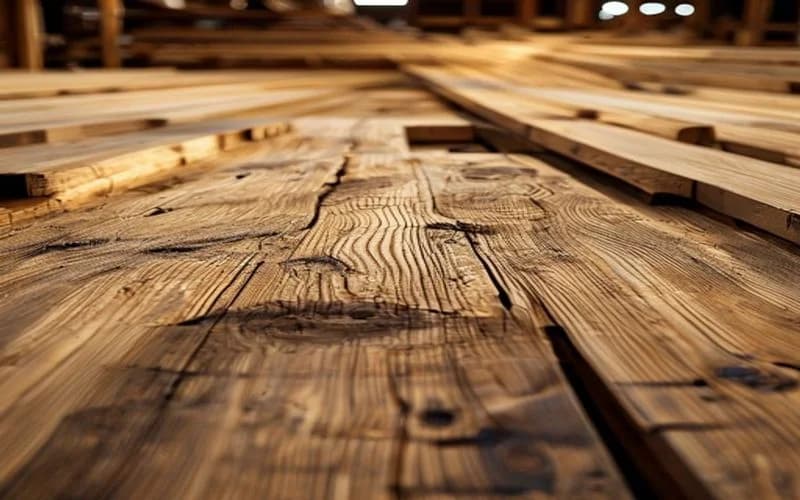
Lauan Plywood Underlayment: Architectural Grading and Shop Performance
Lauan is the default budget underlayment sheet. Discover its grading categories, core quality limits, and why it is not designed for fine furniture.
Giang Nguyen
Wood Manufacturing Expert
The Budget Panel: What Is Lauan?
Lauan plywood — also spelled Luan — is one of the most common plywood sheets sold in big-box home improvement stores. Often labeled as "utility panel" or "underlayment," Lauan is a cheap import product made from Southeast Asian hardwoods in the *Shorea* genus (often referred to as Philippine Mahogany, though it is not true mahogany).
Lauan is typically sold in thin sheets (1/4-inch or 5.2mm) and is widely used for floor underlayment, door skins, drawer bottoms, and temporary shop fixtures. However, Lauan is a low-cost utility product that comes with major engineering limits. The core is often full of voids, the face veneer is paper-thin and easily damaged, and it is highly sensitive to moisture. Let's unpack the material science of Lauan plywood so you can use it correctly without ruining your work.
Physical and Mechanical Specifications
Lauan is a lightweight, low-density plywood. It lacks the stiffness and hardness required for structural framing or fine furniture carcasses:
| Technical Property | Lauan Plywood (1/4") | Radiata Pine Plywood (1/4") | Baltic Birch (6mm) |
|---|---|---|---|
| Density (kg/m³) | **420–460** | 480–520 | 680–720 |
| Janka Hardness (lbf) | **450–550** | 680–750 | 1,260 |
| MOR (Strength - MPa) | **45–55** | 62–70 | 74 |
| MOE (Stiffness - MPa) | **6,500–7,800** | 9,800–10,500 | 11,500 |
Underlayment Grading: The OGP and Type II Standards
Lauan is primarily manufactured as a flooring underlayment substrate. When vinyl, linoleum, or carpet is installed, a smooth, consistent base is required to prevent defects in the subfloor from showing through the finish flooring. Lauan is graded to meet these requirements under the International Wood Products Association (IWPA) standards:
OGP (Overlay Grade Panel)
OGP is the premium grade of Lauan. The face veneer is sanded smooth, matches for color, and is virtually free of open patches, knots, or splits. This grade is suitable for doors skins and visible utility paneling.
Underlayment Grade (Type II / Interior Glue)
This is the standard utility sheet. The face may have color variations, small tight knots, and synthetic filler patches. The critical specification is the core quality: the inner plies must be tightly jointed to prevent large core voids that could collapse under the weight of foot traffic or heavy furniture.
Beware of ultra-cheap import Lauan that is not certified to these standards. Non-certified sheets often have massive internal voids and overlapping plies that make the panel lumpy and prone to cracking under concentrated loads.
[CTA BUTTON: Check Current Price on Amazon]
The Paper-Thin Face: Sanding and Cutting Hazards
The biggest challenge when working with Lauan plywood is the thickness of the face veneer. In budget Lauan panels, the face veneer is often 0.2mm to 0.4mm thick (1/120 to 1/64 of an inch). This is literally paper-thin.
If you try to sand Lauan plywood with a power sander, you will sand through the face veneer to the glue line within seconds, exposing the white glue and coarse core fibers below. Sand Lauan only by hand with 220-grit paper, using minimal pressure. When cutting Lauan, the thin face veneer will splinter easily on the exit side of the cut. Always use a zero-clearance throat insert and a high-tooth crosscut blade, or make a scoring cut with a utility knife before sawing.
Moisture Sensitivity and the Delamination Threat
Most Lauan plywood is bonded using Type II Interior Urea-Formaldehyde (UF) adhesive. This glue has very low water resistance. If Lauan gets wet, the glue bonds will break down, causing the plies to bubble, buckle, and delaminate.
Never use Lauan plywood in bathrooms, kitchens, laundries, or outdoor structures. If you are using Lauan as floor underlayment, verify that the concrete slab has a proper vapor barrier, and seal the edges of the Lauan sheets to prevent moisture from cleaning mops or spills from seeping into the core.
Lauan in the Shop: Best Practices
While Lauan is not a furniture-grade wood, it is highly useful in the shop if you work within its limits:
- Drawer bottoms: Lauan is cheap and lightweight, making it excellent for drawer bottoms in light-duty shop organizers or storage cabinets.
- Shop jigs and templates: Use 1/4-inch Lauan to make quick templates for routing curves or layout marks. It cuts easily and is cheap enough to throw away after use.
- Dust covers: Install Lauan panels on the backs of cabinet carcasses to keep dust out, using staple guns or small brad nails to secure the sheet.
When fastening Lauan, use thin fasteners. Standard wood screws can split the soft, thin panel. Use 18-gauge brad nails or narrow-crown staples, and space them every 4 to 6 inches along the edges to prevent the panel from buckling.
Common Questions
Is Lauan the same as Philippine Mahogany?
Yes, historically "Lauan" was marketed as Philippine Mahogany because the wood looks similar to genuine mahogany when finished. However, Lauan is not related to true mahogany (*Swietenia macrophylla*). It is a Shorea species with lower density, hardness, and durability than genuine mahogany.
Can I paint Lauan plywood?
Yes, Lauan paints well. However, because it is open-grained, the wood will absorb paint unevenly. Apply a high-quality primer first to seal the pores, sand lightly with 220-grit, and then apply two coats of latex or acrylic paint for a clean, uniform finish.
Why does my Lauan underlayment smell when wet?
If Lauan gets wet, the urea-formaldehyde adhesive will hydrolyze, releasing a sharp, sour chemical odor. This is a clear indicator that the glue is failing and the panel is starting to delaminate. The panel must be replaced immediately.
Bottom Line
Lauan plywood underlayment is a cost-effective, lightweight utility panel designed for flooring substrates and temporary projects. Respect its thin face veneer, avoid water exposure, and keep it out of high-end furniture builds to ensure a successful project.
[CTA BUTTON: Check Current Price on Amazon]
Want to see our testing in action?
Browse our expert-tested standing desk reviews with real lab data.
Explore Reviews