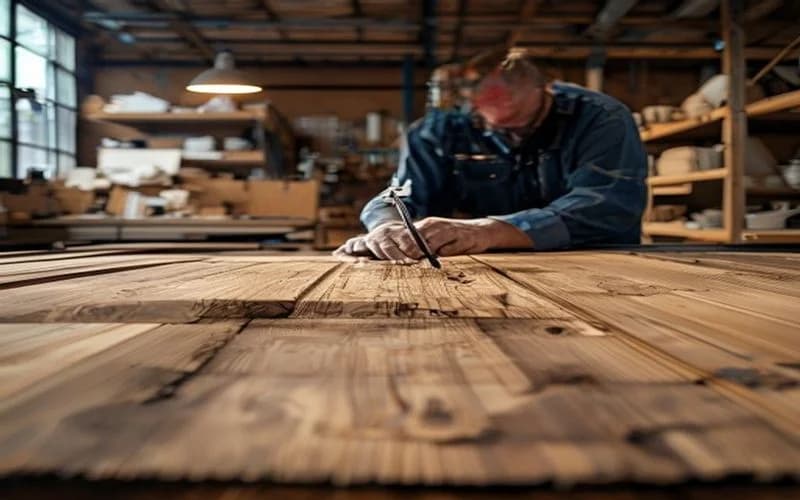
The Woodshop Inspector: How to Screen Plywood Sheets Before Loading
Do not trust a lumberyard stack blindly. Learn how to inspect face veneers, core voids, moisture levels, and flatness at the warehouse.
Giang Nguyen
Wood Manufacturing Expert
The Inspector's Discipline
When you buy high-grade plywood, you are making a major financial investment. A single sheet of A-grade cherry or walnut plywood can easily cost over $150. Despite the high price, quality control at mills can vary, and panels can be damaged during shipping, storage, and handling. If you simply load the sheets from the lumberyard stack onto your truck without inspecting them, you will inevitably end up with warped, damaged, or defective material back at your shop.
Developing a systematic inspection routine at the lumberyard is essential. By taking five minutes to screen every sheet before loading, you can identify manufacturing defects, shipping damage, and moisture issues, saving you from wasting time and money on unusable material.
The Inspection Checklist: What to Look For
Set up a temporary inspection station on your trailer bed or a clean workspace near the lumber rack. Inspect each sheet against these five critical criteria:
1. Flatness and Warp
Sight down the long edge of the panel at eye level. Look for four types of warp: cup (curvature across the width), bow (curvature along the length), twist (opposite corners lifting), and crook (curvature along the edge).
To measure warp accurately, lay the sheet flat on a level concrete floor. If a corner lifts by more than 1/4 inch on a 4x8 sheet of 3/4-inch plywood, reject it. Warped sheets are difficult to cut safely on a table saw and will cause alignment issues during assembly.
2. Edge Profile and Core Voids
Examine the exposed edges of the panel. Look for gaps, overlaps, and putty patches in the inner plies. The table below lists the maximum acceptable defects by plywood grade:
| Plywood Grade / Standard | Max Core Voids Allowed | Max Ply Overlaps | Putty Patches Allowed on Edges | Thickness Tolerance |
|---|---|---|---|---|
| **BS 1088 Marine** | **None (≤1mm gap)** | **None** | **None** | **+0.2 to -0.2mm** |
| **HPVA Grade A-1** | Gaps under 1/4" | Max 1 per edge | Minor, neat fills | +0.3 to -0.3mm |
| **HPVA Grade B-2** | Gaps under 1/2" | Max 2 per edge | Allowed | +0.4 to -0.4mm |
| Shop / Utility Grade | Unlimited | Unlimited | Unlimited | +0.5 to -1.0mm |
Reject any premium cabinet sheet that contains visible voids larger than 1/4 inch. Voids weaken the edge, compromise screw-holding strength, and can cause the face veneer to collapse during routing.
3. Face Veneer Quality and Sand-Through
Inspect the face veneer under good lighting. Look for sand-through, which occurs when the mill's wide-belt sander eats through the thin face veneer, exposing the dark glue line and core wood below. Sand-through is a permanent defect that cannot be hidden by finish. Additionally, check for glue bleed-through (where adhesive has migrated through the face pores), grain splits, and barber-poling (alternating light/dark bands on book-matched sheets).
4. Moisture Content (MC)
Use a pinless wood moisture meter to check the moisture content of the panel. Cabinet-grade plywood should have a moisture content between 6% and 8%. If the moisture content is above 10%, the panel will warp as it dries in your shop. High moisture content can also cause glue failure and wood rot. If the sheets feel damp or register high moisture levels, reject them.
[CTA BUTTON: Check Current Price on Amazon]
5. Shipping and Handling Damage
Check the corners and edges of the sheets for impact damage. Plywood bundles are often moved with forklifts, and the forks can easily dent or crack the edges of the panels. Also, inspect the faces for deep scratches, strap burns, or dirt ground into the grain. While minor edge damage can be trimmed away, deep face scratches will require heavy sanding that can ruin thin veneers.
How to Handle Defective Material
If you find a defective sheet during inspection, do not be afraid to reject it. Politely show the defect to the lumberyard employee and ask for a replacement. Reputable distributors expect professionals to inspect their material and will gladly help you swap out damaged sheets.
If a sheet has minor defects but is still usable for secondary parts, ask the warehouse manager for a discount. Distributors will often sell "shop-grade" or slightly damaged sheets at a 20% to 50% discount, providing excellent value for utility shelves or drawer boxes.
Bottom Line
Inspecting plywood before loading is a simple, effective way to protect your shop's bottom line. By checking for flatness, core voids, sand-through, moisture levels, and shipping damage, you will ensure that you only pay for high-quality, usable material. Keep your moisture meter handy, sight your edges, and reject defective sheets to build with confidence.
[CTA BUTTON: Check Current Price on Amazon]
Want to see our testing in action?
Browse our expert-tested standing desk reviews with real lab data.
Explore Reviews