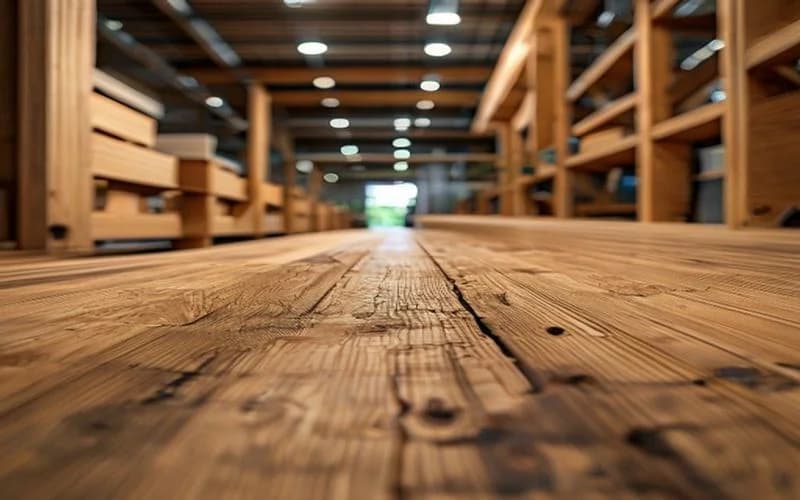
Domestic US Plywood Manufacturers: Columbia Forest Products and the APA Standard
A deep look at North American hardwood plywood mills. From Columbia Forest Products' PureBond soy adhesive to Roseburg and Murphy, learn about domestic engineering standards.
Giang Nguyen
Wood Manufacturing Expert
The American Hardwood Mill Infrastructure
While imported plywood from South America and Asia dominates the low-cost structural and utility market, domestic North American mills remain the premier source for high-quality architectural panels. Brands like Columbia Forest Products, Roseburg Forest Products, and Murphy Plywood manufacture panels utilizing domestic hardwood cores—primarily yellow poplar (*Liriodendron tulipifera*), sweetgum, and soft maple—faced with premium domestic hardwood veneers like red oak, white oak, maple, and walnut.
Domestic manufacturers build panels to the voluntary ANSI/HPVA HP-1-2020 standard, which dictates strict tolerances for veneer thickness, core voids, moisture content, and formaldehyde emissions. If you are building custom residential cabinetry or high-end commercial millwork, understanding the engineering standards and adhesive systems of US mills is essential for delivering compliant, durable work.
Technical Specs: Domestic Poplar Core Plywood
Domestic veneer-core panels are generally lighter, more uniform in thickness, and contain fewer core voids than low-cost imports. The table below details the engineering specifications of typical 3/4-inch (18mm) domestic poplar core panels compared to common imports:
| Mechanical Property | US Poplar Core (HPVA) | Chinese Poplar Core | US Combi Core (Poplar/MDF) | Douglas Fir Core (APA) |
|---|---|---|---|---|
| Density (kg/m³) | **460–490** | 420–460 | 580–620 | 500–550 |
| Janka Hardness (lbf) | **540** | 480 | 680 | 710 |
| MOE (Stiffness - MPa) | **10,100** | 7,800 | 11,200 | 11,500 |
| MOR (Strength - MPa) | **69** | 52 | 75 | 78 |
| Face Screw Holding (N) | **850** | 680 | 950 | 850 |
| Edge Screw Holding (N) | **750** | 580 | 850 | 650 |
| Thickness Tolerance (mm) | **+0.4 to -0.4** | +0.5 to -0.8 | +0.2 to -0.2 | +0.4 to -0.4 |
As shown, domestic panels offer significantly tighter thickness tolerances (+0.4 to -0.4mm) than Chinese imports. This precision is critical for woodshops utilizing CNC routers, where thickness variations can result in incomplete cuts or loose joinery.
PureBond Soy Adhesive: Formaldehyde-Free Chemistry
Historically, plywood mills relied on urea-formaldehyde (UF) glues, which off-gas formaldehyde over time. In response to consumer demand and environmental regulations, Columbia Forest Products pioneered PureBond technology, a soy-protein-based adhesive chemistry.
This eco-friendly adhesive utilizes soy flour combined with a cross-linking resin to form a highly moisture-resistant bond that mimics the natural adhesive properties of marine mussels. PureBond panels offer several technical advantages:
- Formaldehyde-Free: Zero added formaldehyde (NAF), easily exceeding CARB Phase 2 and EPA TSCA Title VI emission limits.
- Excellent Water Resistance: Passes the ANSI/HPVA HP-1 three-cycle soak test, verifying that the panels will not delaminate under high-humidity conditions (kitchens, bathrooms).
- Laser Safe: Unlike UF resins, which release toxic fumes under laser cutting, soy-based adhesives burn cleanly, leaving minimal char and no toxic off-gassing.
[CTA BUTTON: Check Current Price on Amazon]
Shop Performance and Workability
Yellow poplar is the workhorse of the domestic plywood industry. It is a straight-grained, uniform hardwood that is incredibly easy to machine. Unlike tropical imports, poplar contains very little silica, meaning your saw blades and CNC router bits will stay sharp significantly longer.
When processing domestic poplar core panels:
- Adjust Spindle Speed: Poplar is easy to cut, so you can run higher feed rates (e.g., 200–250 inches per minute on a CNC) without bogging down the spindle or overheating the bit.
- Prevent Edge Compression: Because poplar is relatively soft (Janka hardness of 540 lbf), the edges of veneer-core sheets are easily crushed by the high-pressure rollers of automatic edge-banders. Adjust your machine's pressure settings to avoid leaving roller marks on the face veneer.
- Check Back Veneers: Domestic panels typically use a "1" or "2" grade back veneer, which allows for natural color variations and small patches. For panels where both sides are visible (like open shelving), specify an "A/A" or "A/B" grade to ensure a clean appearance on both faces.
Bottom Line
Domestic US plywood manufacturers like Columbia Forest Products offer premium-grade panels that outperform cheap imports in thickness tolerance, workability, and environmental safety. By utilizing soy-based adhesives and uniform poplar cores, these panels provide woodworkers with a reliable, healthy, and easy-to-machine substrate for high-end cabinetry.
[CTA BUTTON: Check Current Price on Amazon]
Want to see our testing in action?
Browse our expert-tested standing desk reviews with real lab data.
Explore Reviews