Combi Core Plywood: Engineered Stability and Weight Balance
An engineering breakdown of combi core plywood. Learn how alternating plies of hardwood and softwood deliver the ultimate balance of weight, flat stability, and screw retention.
Giang Nguyen
Wood Manufacturing Expert
The Best of Both Worlds: Hybrid Engineering
If you ask a custom cabinet maker what core they prefer for high-end kitchen installs, the answer is often combi core (combination core). Combi core plywood is not a single species product; it is a hybrid panel engineered to solve the natural weaknesses of both pure hardwood and pure softwood cores.
By alternating inner plies of a lightweight softwood (like pine or fir) with a dense, stable hardwood (like eucalyptus or poplar), combi core panels achieve a balance of weight, flatness, screw-holding power, and cost that monolithic cores cannot touch. Let's look at the engineering behind these hybrid panels and why they are the professional's choice for premium cabinet builds.
The Engineering Behind Combi Core Plywood
In a standard veneer-core panel, all the inner plies are the same species group. A softwood panel has all softwood plies; a hardwood panel has all hardwood plies.
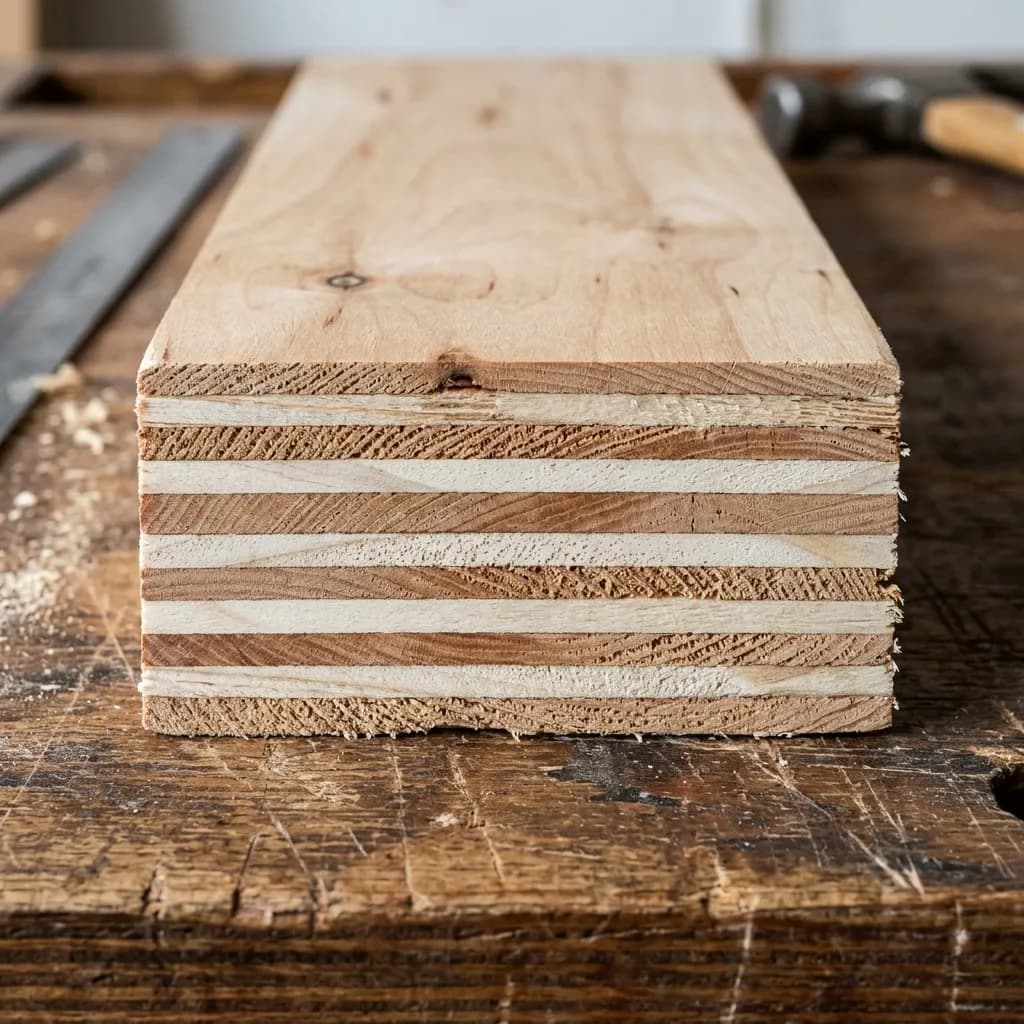
Combi core panels change this by layering different species in a balanced, symmetrical sandwich. A typical 7-ply combi core panel is structured as follows:
- Face Veneer: Hardwood (e.g., Red Oak, Maple, Walnut)
- Crossband: Dense Hardwood (e.g., Poplar or Eucalyptus) — provides a smooth surface to prevent telegraphing
- Core Layer 1: Lightweight Softwood (e.g., Radiata Pine) — reduces overall panel weight
- Center Ply: Dense Hardwood (e.g., Poplar) — provides structural stiffness and flat stability
- Core Layer 2: Lightweight Softwood (e.g., Radiata Pine) — matches layer 3 for balance
- Back Crossband: Dense Hardwood (e.g., Poplar or Eucalyptus) — matches layer 2
- Back Veneer: Hardwood matching face grade or utility grade
This alternating layup balances the high tensile strength of the hardwood plies with the low density and compressibility of the softwood plies. The result is a panel that stays flatter than pure hardwood under humidity swings and holds screws far better than pure softwood.
Technical Specifications and Performance Metrics
| Core Type | Average Density (kg/m³) | Panel Weight (3/4" 4×8 - lbs) | MOE (Stiffness - MPa) | MOR (Strength - MPa) | Face Screw Holding (N) | Edge Screw Holding (N) |
|---|---|---|---|---|---|---|
| **Combi Core** | **550–590** | **68–74** | **11,800–13,200** | **78–92** | **1,020–1,150** | **850–980** |
| Pure Poplar Core | 450–480 | 58–62 | 10,300 | 69 | 750–850 | 750–850 |
| Pure Eucalyptus Core | 640–710 | 82–90 | 12,500–14,800 | 88–105 | 1,050–1,250 | 1,050–1,250 |
| MDF Core | 720–760 | 92–98 | 3,200 | 35 | 850–950 | 500–600 |
Combi core strikes the perfect middle ground. It is significantly lighter than a pure eucalyptus or MDF core sheet, saving your back during shop transport, yet it retains 90% of the stiffness and screw-holding strength of a solid hardwood panel. This weight-to-strength ratio is why combi core is highly favored for large cabinet doors that must resist sagging over time without overloading the hinges.
[CTA BUTTON: Check Current Price on Amazon]
Preventing Warp: Symmetrical Layup Rules
The key to combi core's legendary stability is symmetry. Plywood warps because wood expands and contracts across its grain as it absorbs or loses moisture. If a plywood panel is asymmetrical — meaning the layers on the top half of the sheet do not match the layers on the bottom half — the forces will be unbalanced, and the sheet will cup.
Quality combi core manufacturers use strict layup formulas to ensure that every ply has a matching counterpart on the opposite side of the center line. This balance cancels out internal drying stresses. When buying combi core, always inspect the edge of the panel to verify that the hardwood and softwood plies are arranged symmetrically around the center core ply. Avoid budget imports where the core layout looks random or inconsistent.
Workability: Cutting, Machining, and Tool Life
Because combi core panels mix soft and hard woods, they machine beautifully. The table saw blade cuts through the soft pine layers with minimal resistance, which reduces heat buildup, while the dense hardwood layers support the delicate face veneer, reducing tear-out on the exit side of the cut.
On a CNC router, combi core allows for faster feed rates than solid eucalyptus or birch cores, while still delivering clean, crisp edge profiles. Standard carbide compression bits will last significantly longer when routing combi core compared to cutting pure hardwood cores, as the abrasive silica-heavy hardwood plies are cushioned by the soft, clean softwood plies.
Edge-Banding Performance
Combi core panels are excellent substrates for edge-banding. The dense hardwood crossband plies provide a solid, smooth base for hot-melt adhesives, while the softwood layers allow the glue to bite deep into the panel core.
Unlike pure softwood cores, which can collapse under the pressure of automatic edge-bander rollers, combi core resists compression, ensuring a consistent thickness and a clean, flat edge-band application. If you are using thin wood veneer edge-banding, you will not have to worry about core voids or gaps showing through the banding, as combi core is manufactured to tight tolerances with minimal internal voids.
Common Questions
Is combi core better than MDF core?
For structural cabinets and shelving, yes. Combi core is much lighter, has vastly superior screw-holding power (especially on the edges), and does not sag like MDF. However, MDF core is flatter and provides a smoother surface for high-gloss paint or ultra-thin veneers. If you are building paint-grade doors, MDF is excellent; if you are building cabinet carcasses, combi core is the winner.
Can I use combi core for outdoor projects?
No. Combi core panels are designed for interior architectural woodworking and high-end cabinetry. The softwood plies (often pine) and hardwood plies (often poplar or eucalyptus) do not possess natural decay resistance, and the glues used are typically interior MR or melamine-urea-formaldehyde (MUF) Exposure 1 grades, not waterproof exterior phenolics. For outdoor work, use marine-grade or exterior-rated panels.
How do I identify combi core at the lumber yard?
Look at the edge of the sheet. You will see alternating bands of color. The softwood plies (like pine) will appear light yellow or cream-colored, while the hardwood plies (like poplar or eucalyptus) will appear darker tan or reddish-brown. The plies should be arranged in a neat, alternating pattern that is mirrored around the center line of the sheet.
Bottom Line
Combi core plywood represents the sweet spot of modern panel engineering. By combining the lightweight workability of softwoods with the dense stability of hardwoods, it gives woodworkers a flat, strong, and highly machinable panel that outperforms single-species alternatives. Keep a stack in your shop for your next premium cabinet build.
[CTA BUTTON: Check Current Price on Amazon]
Want to see our testing in action?
Browse our expert-tested standing desk reviews with real lab data.
Explore Reviews