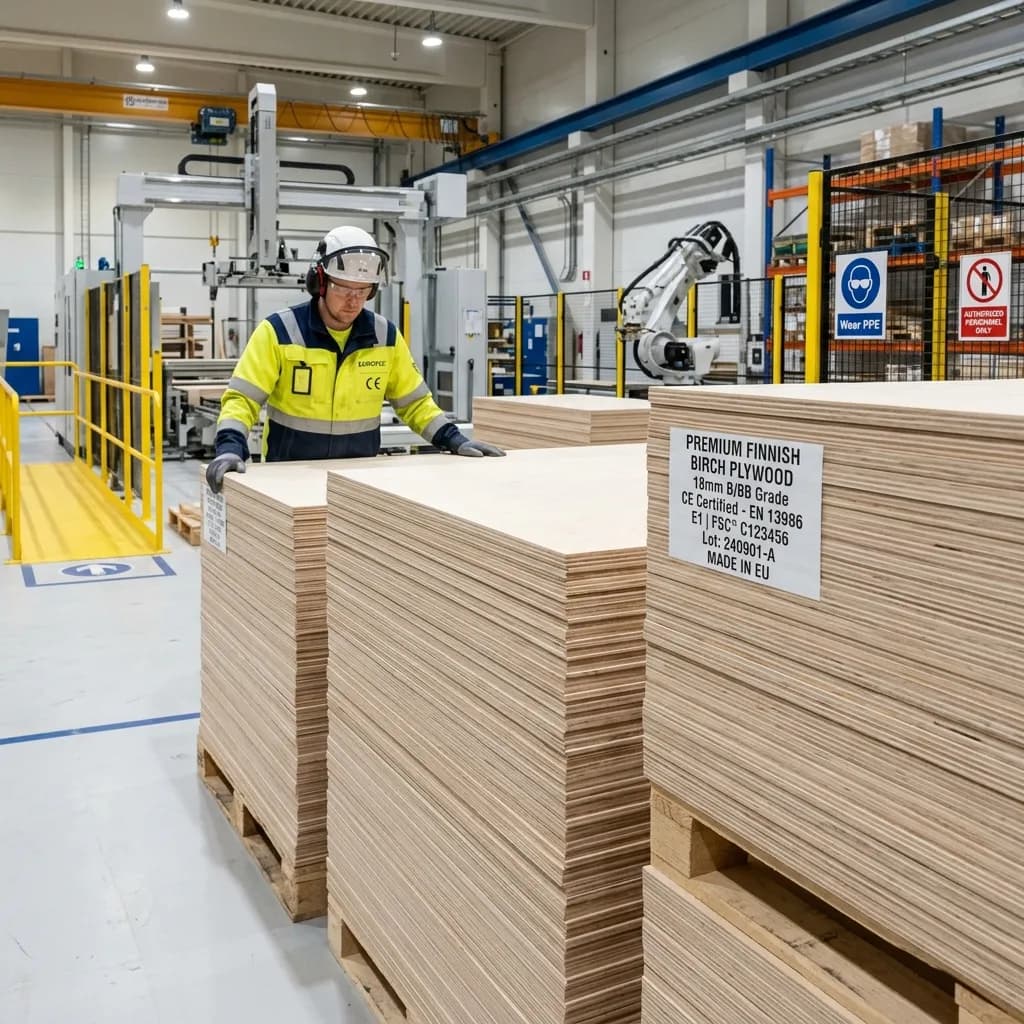
CE Mark EN 13986 & EN 314-2: European Standards for Plywood Panels
A complete guide to European structural wood conformity, bonding quality classes, and E1 formaldehyde limits.
Giang Nguyen
Wood Manufacturing Expert
European Plywood Standards Explained: CE Mark & EN 13986
When importing wood products or buying European Birch plywood in the US, you will notice markings like CE, EN 13986, and EN 314-2. These represent the European Union's harmonized standards regulating the safety, durability, and mechanical properties of wood-based panels used in construction.
1. CE Mark (EN 13986)
The CE Mark under standard EN 13986 proves that a plywood panel complies with EU safety, health, and environmental requirements. If a plywood panel is used structurally in a building, it *must* carry this CE marking.
Key properties verified under EN 13986:
- Bending strength and stiffness.
- Release of formaldehyde (E1 vs. E2 classification).
- Reaction to fire.
2. EN 314-2: Plywood Bonding Quality
The EN 314-2 standard classifies the moisture resistance and durability of the adhesive bond between the veneer layers. It determines where the plywood can safely be used:
Class 1: Dry Conditions (Interior)
Designed for interior furniture in dry rooms. Uses urea-formaldehyde glue.
- *Example:* Drawer bottoms, interior cabinets.
Class 2: Humid Conditions (Protected Exterior)
Suitable for humid indoor environments (bathrooms, kitchens) or protected outdoor applications.
- *Example:* Subfloors, bathroom cabinets.
Class 3: Exterior Conditions (Unprotected Exterior)
Bonding capable of withstanding weather, boiling water, and permanent exposure. Uses Phenol-formaldehyde or WBP adhesive.
- *Example:* Marine hulls, structural roof cladding, concrete formwork.
3. Formaldehyde Emission Classes (E1 vs. E2)
European standards classify formaldehyde emissions under EN 13986 into two classes:
- E1 Class (Safe for Indoor Use): Emissions are limited to 0.1 ppm (parts per million)—comparable to CARB/EPA limits. All premium European birch plywoods conform to E1.
- E2 Class (Exterior Use Only): Higher emissions (between 0.1 ppm and 0.3 ppm). Must not be used inside homes.
Quick Reference Summary
| Standard | What it Measures | Target Classes |
|---|---|---|
| :--- | :--- | :--- |
| **EN 13986** | Structural panel safety & CE conformity | Pass/Fail for construction |
| **EN 314-2** | Glue bonding durability & water resistance | **Class 1** (Dry), **Class 2** (Humid), **Class 3** (Exterior/WBP) |
| **EN 636** | Durability of the wood species used | **EN 636-1** (Dry), **EN 636-2** (Humid), **EN 636-3** (Exterior) |
| **EN 13986 (Formaldehyde)** | Formaldehyde off-gassing rate | **E1** (Safe indoor), **E2** (Exterior only) |
Want to see our testing in action?
Browse our expert-tested standing desk reviews with real lab data.
Explore Reviews