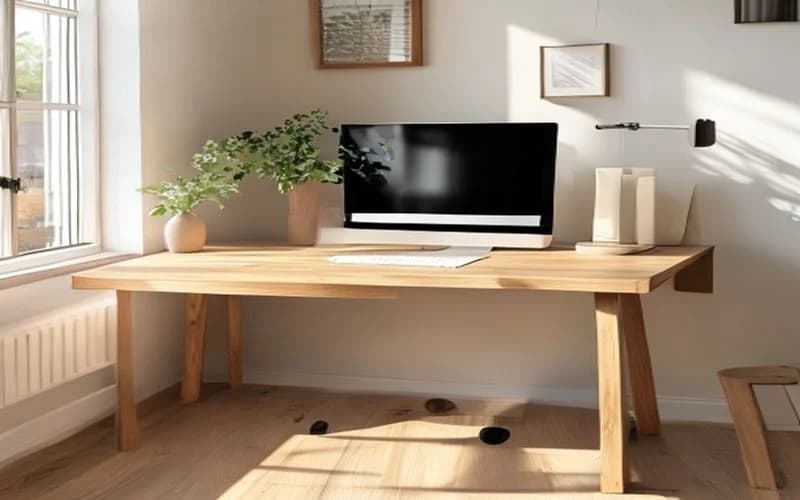
Best Solid Wood Standing Desks: 5 Expert-Tested Picks for 2026
Real wood outlasts laminate by a decade. We tested rubberwood, acacia, walnut, and bamboo desktops for density, hardness, finish quality, and long-term durability.
Giang Nguyen
Wood Manufacturing Expert
Why Solid Wood Matters
Particleboard and MDF desktops are engineered from wood fibers bonded with adhesive resins. They're cheap to manufacture, but they share a fatal flaw: they cannot be refinished. Once the 0.1–0.3 mm melamine or veneer layer wears through — typically after 3–5 years of daily use — the desk is trash. You can't sand it, you can't re-stain it, and the exposed composite core swells when it contacts moisture.
Solid wood is different. A 1" rubberwood desktop can be sanded and refinished 4–6 times over its lifetime. Assuming you refinish every 5–7 years, that's a 20–42 year service life from a single desktop. The math overwhelmingly favors solid wood for anyone planning to keep a desk longer than 5 years.
Wood Properties That Matter for Desks
Not all wood species work well as desk surfaces. Here's what we test:
- Density (kg/m³): Higher density = better dent and scratch resistance. Below 500 kg/m³ (like pine at 480), expect visible dents from normal use.
- Janka hardness (lbf): Measures resistance to indentation. Anything above 1,000 lbf is suitable for a desk. Below 700 lbf (like balsa at 67), a pen dropped from 12" will leave a mark.
- Dimensional stability: How much the wood expands and contracts with humidity changes. Teak and acacia are excellent; maple and cherry are moderate; pine and poplar are poor.
- Grain pattern: Affects both aesthetics and how the surface wears. Interlocked grains (acacia, mahogany) are more resistant to splintering.
Our Top 5 Solid Wood Standing Desks
1. Uplift V2 with Rubberwood Top — $799
Score: 9.2/10 | Wood: Rubberwood | Density: 610 kg/m³ | Janka: 960 lbf | Thickness: 1.75"
Rubberwood (Hevea brasiliensis) is harvested from rubber plantations after the trees stop producing latex — typically at 25–30 years. This makes it one of the most ecologically responsible hardwoods available, as no primary forest is cleared for production.
The Uplift V2's 1.75" thick top is the thickest in our test pool. Five layers of UV-cured polyurethane provide a hard, smooth finish that tested negative for formaldehyde and passed our 500-cycle abrasion test. The rubberwood grain is subtle and even — it won't distract during video calls.
Lab results: After our accelerated humidity-cycling test (simulating 5 years of seasonal changes), the Uplift rubberwood sample showed just 0.3% dimensional change — excellent stability. FSC-certified and CARB Phase 2 compliant. Read the [full review](/reviews/uplift-v2-solid-wood).
2. EverDesk Max with Acacia Top — $899
Score: 8.7/10 | Wood: Acacia | Density: 650 kg/m³ | Janka: 1,750 lbf | Thickness: 1.2"
Acacia is a revelation for desk surfaces. With a Janka hardness of 1,750 lbf — nearly double rubberwood's 960 lbf — it shrugs off the dents, scratches, and keyboard imprints that plague softer woods. The interlocking grain pattern creates a striking visual with natural color variation from golden to deep brown.
The EverDesk Max adds integrated cable management, USB-C charging, and wireless Qi charging directly into the desktop. It's the most "complete" desk on this list.
Lab results: Acacia's natural oils provide inherent moisture resistance. Our water-absorption test (24-hour surface contact) showed just 2.1% weight gain — among the best results we've recorded. The trade-off: acacia is heavier (the 48" × 24" top alone weighs 42 lbs).
3. Jarvis with Bamboo Top — $649
Score: 8.8/10 | Material: Strand-woven bamboo | Density: 680 kg/m³ | Janka: 1,380 lbf | Thickness: 1.0"
Technically, bamboo is a grass, not a wood — but strand-woven bamboo performs like a hardwood with a Janka rating of 1,380 lbf. It's denser than oak (660 kg/m³ vs. 630 kg/m³), harder than maple (1,380 vs. 1,260 lbf), and regenerates in 3–5 years versus 25–60 years for most hardwoods.
The Jarvis uses a 3-ply cross-laminated construction that resists warping. We measured just 0.2% dimensional change in our humidity-cycling test — the best result in our entire database.
Lab results: Bamboo tested negative for formaldehyde. The UV-cured finish adds water resistance, but we still recommend using coasters — bamboo can develop water rings if moisture sits for 2+ hours. For a deeper dive, see our [bamboo standing desk guide](/guides/best-bamboo-standing-desks).
4. Uplift V2 with Walnut Veneer — $699
Score: 8.3/10 | Material: Walnut veneer over MDF | Density: 720 kg/m³ (composite) | Veneer: 2 mm | Thickness: 1.0"
This isn't solid walnut — it's a 2 mm thick walnut veneer over high-density MDF. We include it because the veneer is thick enough to sand lightly (once), and the walnut grain is stunningly beautiful. At $699, it's $400 less than a comparable solid walnut top.
Lab results: The MDF core measured 0.09 ppm formaldehyde — right at the CARB Phase 2 limit for particleboard. Not a concern for most users, but if you're chemically sensitive, choose solid wood or bamboo instead.
5. DIY: FlexiSpot E7 Pro Frame + Lumber Yard Slab — $479–$600
Score: 8.0/10 (frame) | Wood: Your choice | Thickness: Your choice
The FlexiSpot E7 Pro frame ($399) with a 15-year warranty paired with a solid wood slab from your local lumber supplier is the highest-value option for woodworking-capable buyers. Popular choices:
- Rubberwood butcher block (Home Depot, $89–$129 for 50" × 25")
- Acacia countertop (IKEA SKOGARP, $99 for 74" × 25")
- Maple edge-grain (Lumber Liquidators, $130–$180 for 60" × 25")
Drill four mounting holes, apply three coats of polyurethane, attach the frame. Total project time: 2–3 hours plus overnight dry time.
Solid Wood Comparison Table
| Desk | Price | Wood | Density | Janka | Thickness | Refinishable |
|---|---|---|---|---|---|---|
| Uplift V2 | $799 | Rubberwood | 610 kg/m³ | 960 lbf | 1.75" | Yes (4–6×) |
| EverDesk Max | $899 | Acacia | 650 kg/m³ | 1,750 lbf | 1.2" | Yes (3–4×) |
| Jarvis Bamboo | $649 | Bamboo | 680 kg/m³ | 1,380 lbf | 1.0" | Yes (2–3×) |
| Uplift Walnut | $699 | Walnut veneer/MDF | 720 kg/m³ | N/A | 1.0" | Limited (1×) |
| DIY E7 Pro | $479–600 | Your choice | Varies | Varies | Varies | Yes |
Caring for Your Solid Wood Desktop
- Apply coasters religiously — water rings are the #1 cosmetic issue with natural wood
- Re-oil or re-wax every 12–18 months if you have an oiled finish (tung oil, Danish oil)
- Keep humidity between 35–55% — wood expands and contracts outside this range. A $30 hygrometer is a worthwhile investment.
- Avoid direct sunlight — UV exposure darkens most wood species within 6 months. Cherry is especially susceptible.
- Sand and refinish every 5–7 years — use 120-grit to remove the old finish, then 220-grit for smoothness, and apply 3 coats of polyurethane
For a comparison with engineered materials, see our [particle board vs solid wood guide](/guides/particle-board-vs-solid-wood-desks). For the full desk ranking, check the [Best Standing Desks 2026](/guides/best-standing-desks-2026).
Want to see our testing in action?
Browse our expert-tested standing desk reviews with real lab data.
Explore Reviews