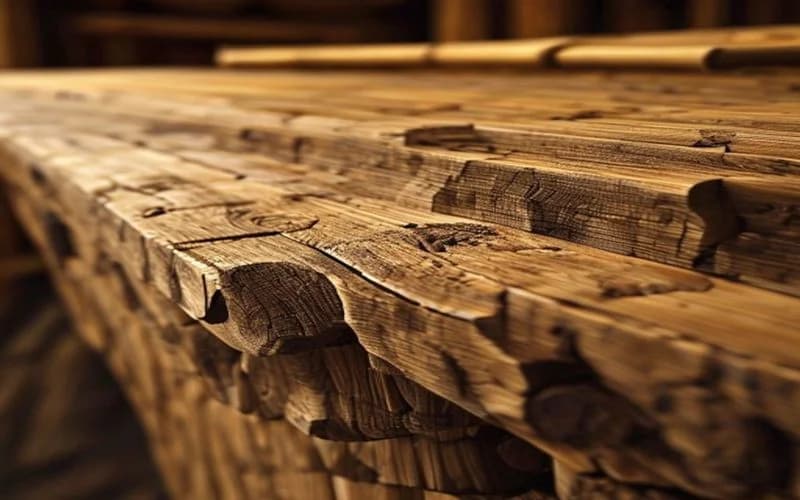
Bamboo vs Rubberwood Standing Desk: Material Science Deep-Dive
Density (640 vs 610 kg/m³), Janka hardness (1,380 vs 960 lbf), sustainability, grain structure, and moisture behavior — a wood-science comparison of the two most popular standing desk surfaces.
Giang Nguyen
Wood Manufacturing Expert
Why These Two Materials Dominate Standing Desks
Bamboo and rubberwood account for roughly 70% of the solid-surface standing desk market above $500. Both are marketed as "sustainable," both look like hardwood, and both cost significantly less than walnut, oak, or maple. But they're radically different materials with different cellular structures, failure modes, and long-term behaviors.
Bamboo isn't even wood — it's a grass. Understanding what that means for your desk surface requires actual material science, not marketing copy.
Physical Properties Comparison
| Property | Strand-Woven Bamboo | Rubberwood (*Hevea brasiliensis*) |
|---|---|---|
| **Density** | 640–700 kg/m³ | 600–640 kg/m³ |
| **Janka Hardness** | 1,380 lbf | 960 lbf |
| **Modulus of Elasticity (MOE)** | 14.0 GPa | 9.1 GPa |
| **Modulus of Rupture (MOR)** | 135 MPa | 71 MPa |
| **Shrinkage (radial)** | 3.1% | 2.2% |
| **Shrinkage (tangential)** | 5.8% | 4.2% |
| **Moisture Content (equilibrium)** | 8–10% | 10–13% |
| **Typical Desktop Thickness** | 1" (25 mm) | 1"–1.75" (25–44 mm) |
| **Grain Pattern** | Linear, parallel fibers | Subtle, straight, uniform |
| **Natural Color** | Pale straw to caramel (carbonized) | Light honey-amber |
| **Refinishable** | Limited (1–2 times) | Yes (3–5 times) |
Key takeaway: Bamboo is harder, denser, and stiffer than rubberwood by significant margins. Rubberwood is more dimensionally stable and far easier to refinish.
Cellular Structure: Grass vs Wood
Bamboo's Fiber Architecture
Bamboo culms (stems) contain vascular bundles — clusters of fibers and vessels — embedded in a matrix of parenchyma cells. In strand-woven bamboo (the type used in premium desks like the [Jarvis Bamboo](/reviews/jarvis-bamboo)), the culms are split into strips, soaked in boric acid to prevent pest infestation, dried to ~8% moisture content, then coated in phenol-formaldehyde resin and compressed at 2,000–3,000 psi.
This process creates a composite material, not a natural one. The compression aligns fibers in parallel, producing exceptional longitudinal strength (hence the 1,380 lbf Janka) but relatively weak cross-grain bonding. The practical implication: strand-woven bamboo resists dents and scratches very well along the surface but can delaminate at edges if the resin bond fails — typically triggered by prolonged moisture exposure.
Rubberwood's Cell Structure
Rubberwood is a diffuse-porous hardwood with relatively small vessels distributed evenly throughout the growth rings. This uniform porosity creates several advantages:
- Consistent machining: Rubberwood cuts, drills, and sands smoothly in all directions. It takes screws well and holds them firmly — important for frame-to-desktop connections that bear dynamic loads during sit-stand transitions.
- Even finish absorption: Stains and finishes penetrate uniformly, producing a consistent appearance. Bamboo's alternating fiber-dense and parenchyma-rich zones absorb finish at different rates, creating a subtle striped appearance that some users find attractive and others find busy.
- Predictable dimensional change: Rubberwood's low shrinkage ratios (2.2% radial, 4.2% tangential) mean it stays flat across seasons. Bamboo's higher tangential shrinkage (5.8%) can cause slight cupping in environments with dramatic humidity swings.
Hardness: What 1,380 vs 960 Lbf Actually Means
The Janka hardness test measures the force required to embed a 0.444" steel ball to half its diameter in the wood surface. At 1,380 lbf, strand-woven bamboo is harder than:
- Red oak (1,290 lbf)
- Walnut (1,010 lbf)
- Ash (1,320 lbf)
Rubberwood at 960 lbf falls between:
- Cherry (950 lbf) — very close
- Walnut (1,010 lbf) — slightly softer
In daily desk use, this means bamboo will show virtually no dents from dropped objects, keyboard friction, or mouse pad movement after years of use. Rubberwood will develop a gentle patina of micro-dents and wear marks — which some users appreciate as character and others view as damage.
If you work with heavy tools, metal components, or frequently place hard objects on your desk, bamboo's hardness advantage is meaningful. For typical office use (keyboard, mouse, coffee mug, monitor), rubberwood's 960 lbf is more than adequate.
Sustainability: Both Are Good, Differently
Bamboo
Bamboo's sustainability credentials are well-documented:
- Regrowth cycle: 3–5 years to maturity vs. 25–60 years for most hardwoods
- Carbon sequestration: Bamboo forests absorb 35% more CO₂ per hectare than equivalent-area hardwood forests
- No replanting required: Bamboo regenerates from existing rhizome networks after harvesting
- Pesticide-free cultivation: Most commercial bamboo (primarily *Phyllostachys edulis*, or moso bamboo) grows without chemical inputs
The caveat: most bamboo is grown in China and Southeast Asia, adding significant transportation emissions for North American buyers. Manufacturing strand-woven bamboo also requires phenol-formaldehyde resin — a petroleum-derived adhesive. The Jarvis Bamboo's manufacturer reports formaldehyde emissions below CARB Phase 2 thresholds (0.05 ppm), which is safe, but the resin itself isn't an eco-friendly material.
Rubberwood
Rubberwood's sustainability story is subtler:
- Waste-stream product: Rubberwood trees are grown primarily for latex production. The wood is harvested when the tree stops producing latex (age 25–30), making the timber a byproduct of the rubber industry rather than a primary-harvest timber.
- No old-growth impact: Because trees are plantation-grown for latex, rubberwood harvesting has zero impact on natural forests.
- FSC certification available: The Uplift V2's rubberwood is FSC-certified, meaning the plantation meets Forest Stewardship Council standards for soil health, water management, and worker conditions.
- Lower processing energy: Rubberwood requires kiln drying and treatment with boron-based preservatives (to prevent rubber-tree-specific fungi), but no high-pressure compression or resin bonding.
The honest comparison: Both materials are genuinely sustainable choices. Bamboo wins on raw regrowth speed and carbon metrics. Rubberwood wins on simpler processing and waste-stream utilization. Neither is greenwashing.
Moisture and Climate Behavior
If you live in a climate with significant seasonal humidity changes (Northeast US, Pacific Northwest, Gulf Coast), this section matters.
Bamboo equilibrium moisture content (EMC) is 8–10%. In humid environments (70%+ RH sustained), bamboo absorbs moisture faster than rubberwood because its compressed fiber structure creates capillary channels. The result: edges can swell by 1–2 mm per 60" of desktop width in extreme conditions. More critically, sustained moisture weakens the phenol-formaldehyde resin bonds, potentially causing surface delamination.
Practical advice: in high-humidity environments, seal bamboo desktop edges with an additional coat of polyurethane and use a dehumidifier to keep ambient RH below 60%.
Rubberwood EMC is 10–13%. It absorbs and releases moisture more slowly and more uniformly. The lower shrinkage ratios mean less dimensional change per percentage point of moisture content change. Rubberwood desktops rarely develop gaps, cups, or warps under normal indoor conditions.
Finish and Maintenance
Bamboo Finish
Most bamboo desktops ship with a UV-cured polyurethane finish — the same technology used on hardwood flooring. This creates a hard, glassy surface that resists water rings and minor scratches. The downside: you can only sand and refinish a strand-woven bamboo surface 1–2 times before you reach the compressed fiber boundary where appearance changes dramatically.
Rubberwood Finish
Rubberwood accepts virtually any finish: polyurethane, tung oil, Danish oil, lacquer, or wax. The Uplift V2 ships with a multi-coat polyurethane that performs well in daily use. Rubberwood can be sanded and refinished 3–5 times over its lifespan, each time restoring a like-new surface. This gives rubberwood a significant lifespan advantage for users who plan to keep their desk for 15+ years.
Desk-Specific Recommendations
Choose Bamboo (Jarvis Bamboo, $649) if:
- You want the hardest natural-material desktop available
- Sustainability is a primary purchase driver
- Your environment is climate-controlled (40–55% RH)
- You prefer a lighter color palette
- You don't plan to refinish the surface
Choose Rubberwood (Uplift V2, $799) if:
- You want maximum dimensional stability
- You live in a variable-humidity climate
- You value the option to refinish the surface over 15+ years
- You prefer a thicker, heavier desktop (1.75" vs 1")
- You want FSC certification
Both are excellent choices — genuinely. This is one of those comparisons where the "wrong" answer is still a very good desk. The real wrong answer is choosing [particleboard with laminate](/guides/ikea-bekant-vs-flexispot-e7) and expecting it to last.
Related: [Best Bamboo Standing Desks](/guides/best-bamboo-standing-desks) | [Best Solid Wood Standing Desks](/guides/best-solid-wood-standing-desks) | [Jarvis vs Uplift Definitive Guide](/guides/jarvis-vs-uplift-definitive-guide)
Want to see our testing in action?
Browse our expert-tested standing desk reviews with real lab data.
Explore Reviews