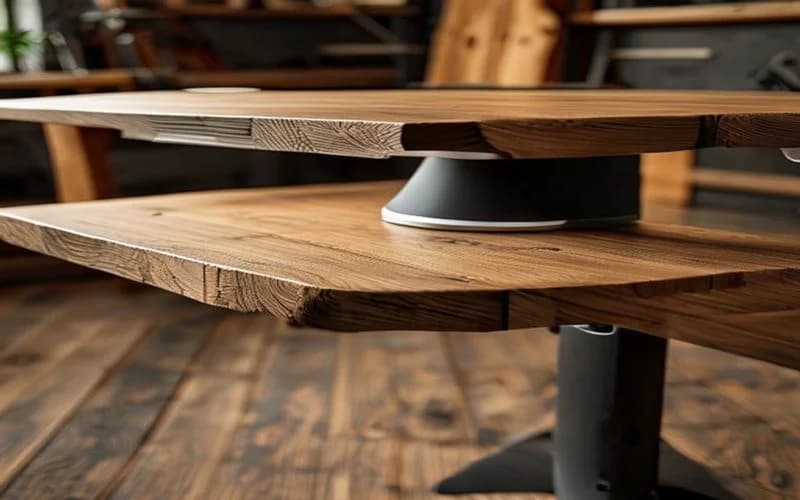
Autonomous SmartDesk Pro vs Uplift V2: Premium Standing Desk Showdown
SmartDesk Pro at $699 (walnut) vs Uplift V2 at $799 (rubberwood). We compare desktop material, stability, motor noise, build quality, and long-term value.
Giang Nguyen
Wood Manufacturing Expert
Two Philosophies, Two Price Points
The Autonomous SmartDesk Pro and the Uplift V2 represent fundamentally different approaches to premium standing desks. Autonomous optimizes for *features per dollar* — you get the widest height range on the market, an app-enabled controller, and a walnut-veneer top for $699. Uplift optimizes for *material integrity* — you get a 1.75" solid rubberwood top, sub-1mm wobble, and FSC certification for $799.
That $100 gap buys very different things. Let's quantify them.
Specification Comparison
| Specification | Autonomous SmartDesk Pro | Uplift V2 |
|---|---|---|
| **Price (as tested)** | $699 (walnut veneer) | $799 (rubberwood solid) |
| **Desktop Material** | MDF core with walnut veneer (720 kg/m³) | 1.75" solid rubberwood (610 kg/m³) |
| **Desktop Thickness** | 1" | 1.75" |
| **Height Range** | 26.2"–52" | 25.3"–50.9" |
| **Motor Type** | Dual motor, direct-drive | Dual motor, direct-drive |
| **Lift Speed** | 1.3"/sec | 1.5"/sec |
| **Weight Capacity** | 310 lbs | 355 lbs |
| **Noise Level** | ~48 dB | ~45 dB |
| **Wobble at Max Height** | 1.9 mm | 0.8 mm |
| **Memory Presets** | 4 (app-enabled) | 4 (keypad) |
| **Anti-Collision** | Yes | Yes (adjustable sensitivity) |
| **Warranty** | 7-year frame / 1-year top | 15-year frame / 5-year top |
| **Certifications** | CARB Phase 2 | FSC, CARB Phase 2, GREENGUARD |
Desktop Material: The Core Difference
SmartDesk Pro: MDF + Walnut Veneer
The SmartDesk Pro's desktop is a 1" MDF (medium-density fiberboard) core topped with a real walnut veneer — typically 0.6–1.0 mm thick. MDF's density (720 kg/m³) actually exceeds rubberwood's (610 kg/m³), which means it's stiffer per unit thickness. However, MDF has critical weaknesses:
- Moisture vulnerability: MDF absorbs water like a sponge when the veneer is breached. A coffee spill that reaches an edge or scratch can cause irreversible swelling within hours
- Screw-holding strength: MDF holds screws at roughly 40% the force of solid hardwood. Over years of sit-stand cycling, this affects the frame-to-desktop connection
- No refinishing: If the veneer scratches through, the repair options are limited to touch-up markers. You can't sand and refinish MDF like solid wood
The walnut veneer itself is attractive — real wood grain, natural variation, and a warm mid-tone brown. Autonomous applies a UV-cured polyurethane finish that tested well in our abrasion resistance evaluation. At arm's length, it's indistinguishable from solid walnut.
Uplift V2: Solid Rubberwood
Rubberwood (*Hevea brasiliensis*) is harvested from rubber trees at the end of their 25–30 year latex-producing life. The Uplift V2's 1.75" thick slab is the thickest desktop in our test pool. Key material properties:
- Janka hardness: 960 lbf — softer than oak (1,290 lbf) but harder than poplar (540 lbf) and most conifers
- Density: 610 kg/m³ — classified as a medium-density hardwood
- Grain: Straight, relatively uniform, with minimal figure. Takes stain well but the natural tone is a light honey-amber
- Moisture resistance: Solid wood handles humidity fluctuations better than MDF because it swells and contracts uniformly rather than delaminating
The 1.75" thickness gives the Uplift desktop a visual heft that the SmartDesk's 1" top can't match. It also contributes to the desk's exceptional wobble score — more desktop mass means a lower center of gravity at full extension.
For a deeper comparison of desk surface materials, see our [bamboo vs rubberwood guide](/guides/bamboo-vs-rubberwood-standing-desk).
Stability: Uplift Wins by a Wide Margin
Our lateral-displacement test at maximum height tells the story:
- Uplift V2 at 50.9": 0.8 mm displacement at 20 N lateral force
- SmartDesk Pro at 52": 1.9 mm displacement at 20 N lateral force
The Uplift is 2.4× more stable. Three factors drive this gap:
- Desktop mass: The Uplift's 1.75" rubberwood top weighs approximately 45 lbs vs. the SmartDesk's 1" MDF top at roughly 30 lbs. More mass at the top dampens oscillation.
- Three-stage vs. two-stage legs: The Uplift uses three telescoping stages per leg with tighter machining tolerances. Each junction point introduces wobble; fewer, tighter junctions means less total play.
- Crossbar design: Uplift's frame uses a wider C-frame footprint (29" vs. 26") with a reinforced crossbar.
At standing height (~42"), both desks feel solid. The difference becomes noticeable above 46" — if you're tall or like an elevated standing position, the Uplift's stability advantage is worth the $100 premium. Read our [best standing desks for tall people guide](/guides/best-standing-desks-tall-people) for more on high-extension stability.
Motor and Electronics
Both desks use dual direct-drive motors — the industry standard for desks above $400. The differences are incremental:
- Lift speed: Uplift at 1.5"/sec vs Autonomous at 1.3"/sec. Full transition: Uplift takes 17 seconds, SmartDesk takes 20 seconds. You won't notice in daily use.
- Noise: Uplift at 45 dB vs Autonomous at 48 dB. Both are quieter than a normal conversation (60 dB). The 3 dB difference is barely perceptible.
- Weight capacity: Uplift at 355 lbs vs Autonomous at 310 lbs. Unless you're running triple monitors with a server rack, both are more than sufficient.
Autonomous's app advantage: The SmartDesk Pro connects via Bluetooth to the Autonomous app, which tracks your sit-stand time, sends reminders, and allows height adjustment from your phone. The Uplift V2 uses a physical keypad with 4 programmable presets — reliable but low-tech. If data-driven habit tracking matters to you, this is a genuine differentiator.
Warranty: This Is Where It Gets Decisive
The warranty gap is the single biggest differentiator in this comparison:
| Component | Autonomous SmartDesk Pro | Uplift V2 |
|---|---|---|
| Frame & motors | 7 years | 15 years |
| Desktop | 1 year | 5 years |
| Electronics | 7 years | 15 years |
Uplift's warranty is more than double Autonomous's on every component. For a desk you'll use 250+ days per year, the frame warranty difference (7 vs 15 years) translates to roughly $57/year for Uplift vs. $100/year for Autonomous in annualized cost.
Autonomous's 1-year desktop warranty is particularly concerning. MDF veneer desktops are most likely to show defects (edge swelling, veneer bubbling, finish clouding) in years 2–4, exactly when the warranty has expired.
Build Quality Details
Autonomous: The frame has a powder-coated finish that's slightly thinner than Uplift's — we measured 55–60 microns vs. Uplift's 70–75 microns using a coating thickness gauge. The controller box is plastic and mounted under the desktop. Cable routing channels are included but feel flimsy. Leveling feet are functional but basic.
Uplift: The frame coating is thicker and more evenly applied. The controller box is metal-enclosed. Cable management includes a steel wire tray with a felt liner. Leveling glides are oversized (2" diameter) with 1.5" of adjustment range — helpful for uneven floors. The desktop edges are finished on all four sides with a rounded bullnose profile.
Assembly Comparison
Autonomous: Ships in two boxes. Assembly takes 40–50 minutes and requires flipping the fully-loaded frame upside down to attach the desktop. The instruction manual is passable. Most users report a manageable solo assembly, though a second person helps when flipping.
Uplift: Ships in two boxes. Assembly takes 30–45 minutes. The frame attaches to the desktop from below — no flipping required. Uplift's instructions are the best in the industry: full-color photos, labeled hardware bags, and a QR code linking to a video walkthrough. Solo assembly is straightforward.
Value Analysis
Let's calculate 10-year total cost of ownership:
| Factor | SmartDesk Pro ($699) | Uplift V2 ($799) |
|---|---|---|
| Purchase price | $699 | $799 |
| Likely desktop replacement (year 3–4) | $150 | $0 |
| Extended warranty purchase | $79 (optional) | Not needed |
| **10-year total** | **$849–$928** | **$799** |
The Uplift V2 is actually cheaper over 10 years because its solid-wood desktop and 15-year warranty eliminate the hidden costs that Autonomous's 1-year desktop coverage creates.
The Verdict
Buy the Uplift V2 if you want the best material quality, longest warranty, and lowest long-term cost. The 1.75" rubberwood top, 0.8 mm wobble, and 15-year warranty make it the objective winner in build quality. This is the desk for anyone who views a standing desk as a long-term investment.
Buy the SmartDesk Pro if you need the tallest max height (52" for users 6'4"+), want app-based sit-stand tracking, or genuinely prefer the look of walnut veneer. At $699, it's a competent desk — it's just not in the same durability league as the Uplift.
For more comparisons at this price tier, see our [Vari vs Uplift V2 guide](/guides/vari-vs-uplift-v2-guide) or the comprehensive [best standing desks 2026 ranking](/guides/best-standing-desks-2026).
Want to see our testing in action?
Browse our expert-tested standing desk reviews with real lab data.
Explore Reviews